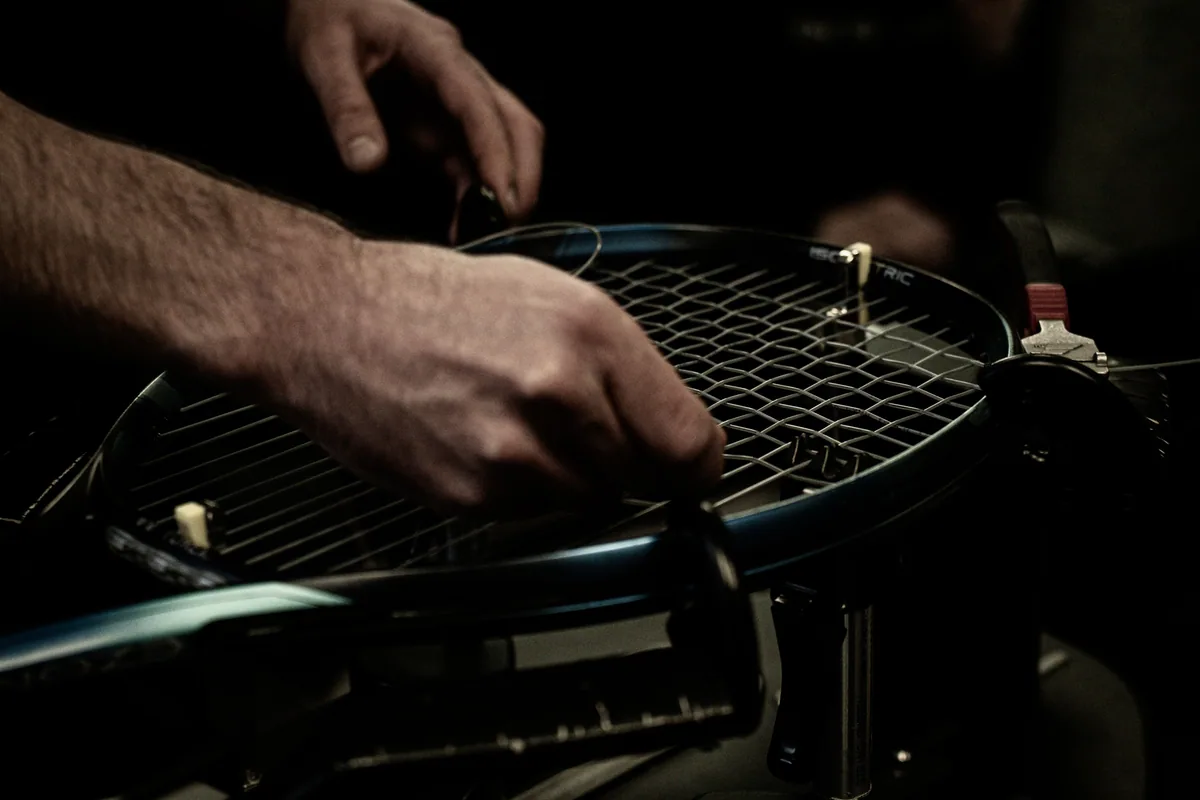
Write down your current string, gauge and tension if you know them. Decide what you want to change, then discuss the next setup with your stringer. Changing one variable at a time makes the comparison easier to interpret.
Record Your Current Setup
Start with the racket model, string name, diameter and installed tension. If you do not know them, ask the shop that last strung the racket. Describe a repeatable problem, such as frequent breakage or difficulty keeping depth, so the next change has a clear purpose.
Separate material from construction
Polyester names a material; monofilament describes a single-filament construction. Multifilament strings combine many filaments. Natural gut and synthetic gut are different product categories: the word gut alone does not identify the material. Check the composition and construction of the exact string. A full bed uses the same string in the mains and crosses; a hybrid combines different strings in those two directions.
Specify the Mains and Crosses in a Hybrid
Babolat RPM Blast 1.25 mm + Touch VS 1.30 mm combines co-polyester and natural gut. The two layouts below use the same pair in different directions. Mains run along the racket; crosses run across it. Give the stringer the layout and a separate tension for each direction, following the frame’s stringing instructions and range.
| Layout | Mains | Crosses |
|---|---|---|
| RPM Blast mains | RPM Blast · 1.25 mm | Touch VS · 1.30 mm |
| Touch VS mains | Touch VS · 1.30 mm | RPM Blast · 1.25 mm |
Compare diameter and tension together
Record both the gauge and diameter in millimeters. Compare the two gauges at the same stringing tension.
| HEAD Synthetic Gut variant | Diameter |
|---|---|
| 16g | 1.30 mm |
| 17g | 1.25 mm |
Make the next restring informative
Keep the racket and playing conditions as similar as practical, and change one setup variable at a time. Note what you actually notice rather than expecting a material name to guarantee a result. Ask your stringer when to reassess the string’s condition; there is no universal calendar for replacement.
- Record the string in the mains and crosses, including each diameter.
- Keep the installed tension and restring date.
- Note playing hours, breakage and changes in feel before the next restring.
When should you replace tennis strings?
Do not wait for a break to review your setup. Babolat gives a general three-month restringing recommendation because tension and temperature affect response. Treat that as a starting point for discussion with your stringer, not a promise that every string will play well for three months.
- Bring your restring date and approximate playing hours.
- Describe persistent changes in depth or feel and show visible wear.
- Agree on the next check based on your string and use.
Your Next String Tension
Give the stringer your racket’s recommended range and the string model you want. If your current tension works, ask for it again. If you want to change the response, describe the problem and agree on a small adjustment within the frame’s range.
Convert kg and lb Before Restringing
If the shop quotes pounds and your previous setup is in kilograms, use the converter to give the same setting. The range checker shows whether that setting lies within the limits you enter. Keep the string name, diameter, mains and crosses tension and date for your next visit.
Where to Fit a String Dampener
The ITF rule allows a vibration dampener only outside the pattern of crossed strings. Keep it outside the area where the main and cross strings meet; follow the device’s fitting instructions.