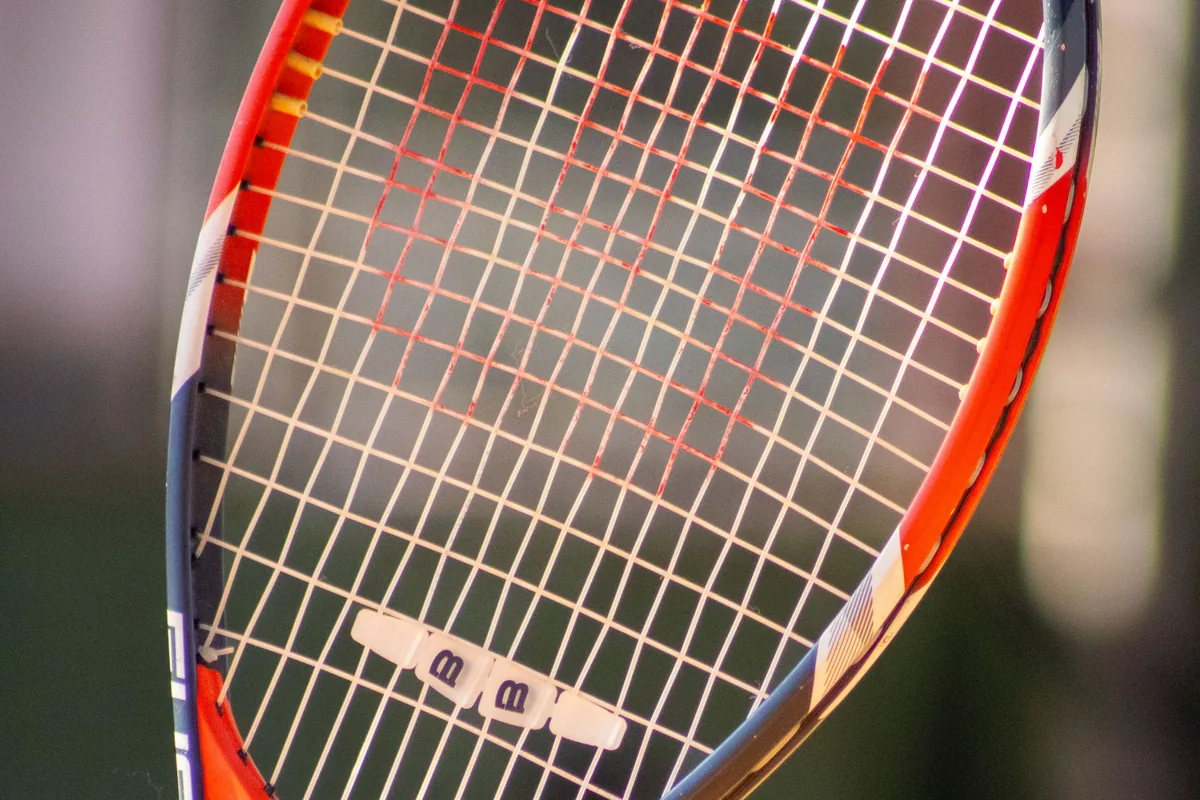
A shortlist built around handling, contact and a realistic playing budget.
Start with your current swing
Look for a racket you can prepare comfortably and use consistently. Level labels are broad. Frequency of play, swing length and the amount of help you want generating depth are more useful starting questions.
Compare the important specifications
Head area, strung weight, balance, swingweight and string pattern describe different properties. Swingweight describes resistance to rotational acceleration, not mass in grams. A 16 × 19 string pattern means 16 main strings and 19 cross strings. Compare weights measured with the same string and accessory setup.
Leave room for strings
String material, tension and condition change the response. A frame comparison made with very different string setups can be misleading. Include stringing and replacement grips in your budget.
Strung and Unstrung Weight
Unstrung weight excludes the strings; strung weight includes them. Your overgrip and dampener add to the playing setup too. Do not rank a strung shop sample against an unstrung catalog figure. Ask for both rackets to be weighed in comparable condition rather than adding a fixed allowance for every string.
A Concrete Starting Point for a First Racket
Babolat lists the Boost Drive Strung for beginners and occasional players. Model 121263 combines a 680 cm² head with a 260 g ± 7 g unstrung weight and a 16 × 19 pattern. It arrives strung, so the weight in your hand will differ from that catalog figure. Compare it with a borrowed racket before deciding; check the grip size and the condition of the supplied strings as part of the first purchase.
A First-Racket Decision Checklist
Start with the problem you want to solve rather than a professional player’s equipment. Use the checks below to narrow a shortlist, then try the grip and playing setup before buying.
| What you notice | What to check |
|---|---|
| Late preparation | compare handling through a full session, including serves and returns. |
| Inconsistent contact | compare head size and actual contact with the same ball. |
| Grip fit | check the grip-size guide before choosing a size. |
| Budget | include stringing, overgrips and balls as well as the frame. |
Keep a shortlist by exact model
Pure Aero, Pure Drive, Blade and Ezone names cover several versions. Keep the model suffix and generation in your notes. Compare one manageable option with one alternative; use the same strings where practical and change only the equipment you are assessing.
Choose a junior racket by length as well as grip
Junior lengths of 21, 23, 25 and 26 inches equal 53.34, 58.42, 63.50 and 66.04 cm. These are racket lengths, not grip sizes. Use height and playing level when trying sizes; age alone is a starting clue. Babolat’s check uses tennis shoes, a relaxed arm pointing down and the racket held by its handle; its suggested clearance is less than 5 cm from the ground. Check handling with the coach before moving to an adult frame.
Two Different Prestige 2026 Configurations
iPrestige MP 2.0 has a 95 in² head and an 18 × 20 pattern. Prestige MP Limited 2026 has a 99 in² head and a 16 × 19 pattern. Compare both with the same string model and diameter.
Defyer 100 V1 and Blade 100 V10: the Balance Difference
Both standard models have 100 in² heads. The table uses unstrung weight and balance measured from the handle end. Defyer’s balance point is 5 mm closer to the handle.
| Measurement | Defyer 100 V1 | Blade 100 V10 |
|---|---|---|
| Head size | 100 in² | 100 in² |
| Unstrung weight | 300 g | 300 g |
| Unstrung balance | 315 mm | 320 mm |
| Length | 27 in | 27 in |
| String pattern | 16 × 19 | 16 × 19 |